
What Happens at a Banya? Parenie, Scrubs, Massage & More

If you expect a banya to be simply a sauna, some of what happens inside can look unusual at first.
People enter a hot, humid steam room, plunge into cold water, rest, return to the heat and then add treatments involving leafy branches, honey, salt, mud, soap or massage.
In a traditional Russian banya, these are not random spa treatments placed around a sauna visit. They are different parts of one bathing ritual.
The simplest way to understand it is:
Steam → Cool → Rest → Treatments → Repeat.
At Banya No.1, a typical three-hour session gives you time to move through this cycle at your own pace, with treatments such as Parenie, Deep Tissue Massage, body scrubs, Honey Detox Massage and Siberian Body Wash fitting naturally between periods of heat, cooling and rest.
The banya is a cycle, not just a hot room
A Russian banya is a traditional form of steam bathing built around repeated cycles of heat, cooling and recovery.
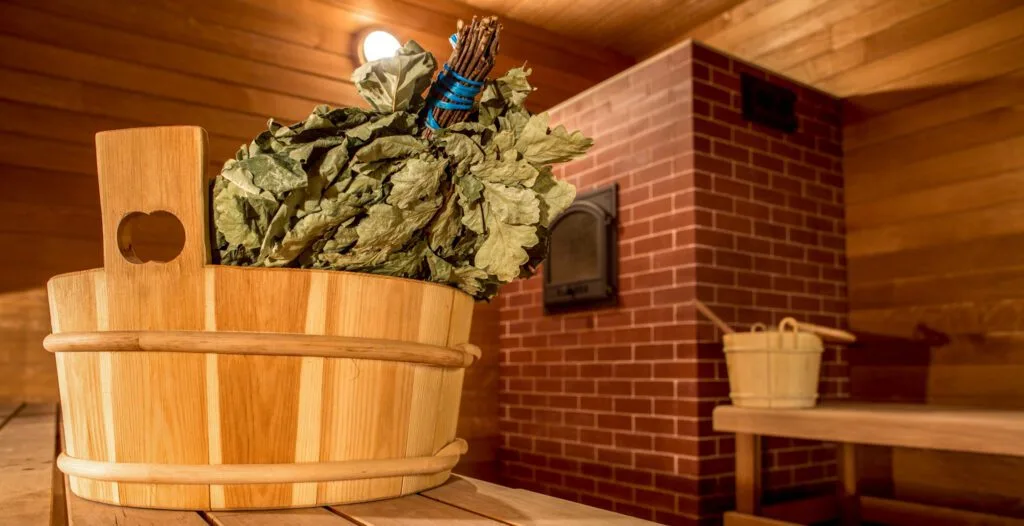
At Banya No.1, the Parnaya is the centre of the experience. It typically operates at 60–70°C with 50–70% humidity, creating a hot, humid environment quite different from the dry heat many people associate with a sauna.
You warm up in the Parnaya, cool down with a shower, bucket or cold plunge, then rest before deciding when to return.
Treatments are added around that basic rhythm.
| Part of the banya | What happens |
| Parnaya | You warm up in hot, humid steam |
| Cold plunge or shower | You cool down after heat exposure |
| Rest | You cool down, rehydrate and recover |
| Parenie | A Steam Master works the steam around your body using leafy veniki |
| Scrubs and body wash | Bathing becomes a cleansing and exfoliating treatment |
| Massage | Hands-on treatment can be added between thermal cycles |
| Repeat | You return to the steam when you are ready |
This is one reason a banya can feel very different from simply spending ten minutes in a sauna.
Is a banya different from a sauna?
Yes, although the difference is more nuanced than saying one uses steam and the other does not.
Russian banya and Finnish sauna are both established bathing traditions. Both involve heat and may include periods of cooling and rest.
One of the clearest differences is the thermal environment.
At Banya No.1, the Parnaya operates at around 60–70°C with 50–70% humidity. This combination of moderate temperature and relatively high humidity produces a dense, enveloping heat.
Another major difference is the role of traditional treatments, particularly Parenie.
In many UK gyms and spas, a sauna is experienced mainly as a hot room within a wider spa visit. In a traditional banya, the steam room is one stage in a much larger bathing ritual.
For a detailed comparison of temperature, humidity and bathing traditions, see our Russian Banya vs Sauna guide.
Parenie: what are the leafy branches actually doing?

Parenie is the signature thermal ritual of the Russian banya.
It is performed in the steam room using veniki — bundles of leafy branches traditionally made from trees such as birch or oak. At Banya No.1, birch, oak and eucalyptus veniki are used.
Despite how it can appear from the outside, the purpose is not simply to hit the body with branches.
A Steam Master uses the veniki to catch, move and concentrate hot, humid air around different parts of the body. The intensity can be varied throughout the treatment, and the hot stage is followed by cold-water exposure.
The venik is therefore a tool for manipulating steam.
This distinction matters because Parenie is sometimes described simply as a “venik massage”. There is physical contact, but the defining feature is the combination of steam, venik technique and thermal contrast.
For many first-time guests, Parenie is the treatment that makes the logic of banya suddenly click.
Why have treatments during a banya session?
You are not expected to spend three hours continuously sitting in steam.
A banya session naturally contains breaks.
You heat up, cool down and rest.
That creates space for treatments.
A typical visit might start with one or more gentle rounds in the Parnaya, followed by cooling and rest. Parenie can then become the centrepiece of the experience, with a scrub, wash or massage taking place later in the session.
There is no need to fit everything into a single visit.
The point is that the treatments work within the rhythm of the bathhouse rather than feeling like unrelated appointments in separate treatment rooms.
Body scrubs: exfoliation belongs in a bathhouse
Washing and exfoliation have always been natural companions to bathing.
That is why a body scrub makes intuitive sense in a banya.
Banya No.1 offers several scrub options using ingredients such as salt, honey, coffee, brown sugar and aloe vera. These provide physical exfoliation and are normally experienced as a short treatment within the wider banya session.
If you have sensitive or reactive skin, tell the team before choosing a scrub so the current treatment options can be discussed with you.
More exfoliation is not necessarily better. The aim is to choose a treatment appropriate for your skin rather than simply selecting the strongest scrub available.
Siberian Body Wash: when washing becomes a treatment
The Siberian Body Wash makes the connection between bathing and treatment even clearer.
The body is covered in silky, soapy foam and washed using a bundle of fragrant birch branches.
Here the venik has a different job from its role during Parenie.
During Parenie it is primarily used to manipulate steam and heat. During the Siberian Body Wash, it becomes part of the physical cleansing process.
For somebody unfamiliar with bathhouse culture, being washed with birch branches can sound eccentric.
Inside a banya, it is simply another way in which water, plants, cleansing and bathing come together.
Honey massage: why put honey on your back?
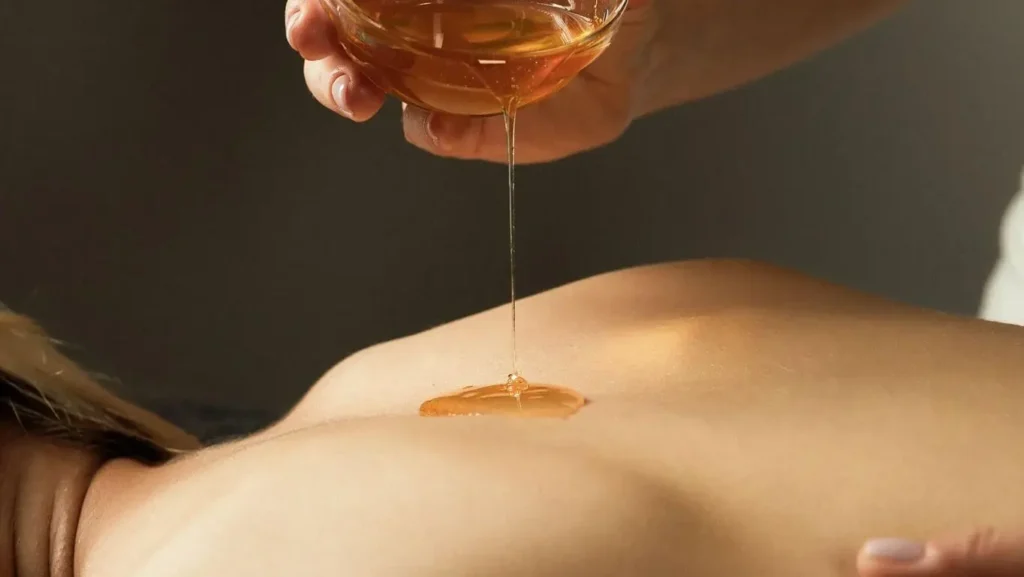
Honey Detox Massage is another treatment that can sound stranger than it feels.
Natural honey is applied to the skin and the therapist uses its sticky texture as part of the massage technique.
As the hands repeatedly make contact with and lift away from the skin, the honey creates a distinctive pulling or vacuum-like sensation.
That produces a very different experience from a conventional oil-based massage.
The word “Detox” forms part of the treatment name, but it is useful to separate the traditional name from medical claims.
Massage can mechanically manipulate soft tissue, while honey acts as the topical medium. Claims that massage physically extracts unspecified “toxins” through the skin should not be confused with established medical detoxification.
The treatment does not need that explanation to be interesting. It is a distinctive massage technique using a material rarely encountered in a conventional spa.
Anyone with a known allergy to honey should avoid treatments containing it.
Deep Tissue Massage after steam

For guests who prefer a more familiar treatment, Deep Tissue Massage can also be incorporated into a banya visit.
Rather than changing the thermal part of the experience, massage adds hands-on work focused on muscles and connective tissue.
This is another reason the banya should not be thought of as three hours in a steam room.
A visit can contain heat, cold, recovery, Parenie and massage, with substantial periods of rest in between.
What about mud treatments?
Mud masks and wraps add another skin-focused element to the visit.
At Banya No.1, guests can choose treatments including a Mud Mask or Full Body Mud Wrap.
Again, the principle is straightforward.
Traditional bathhouses have always been places where people wash and care for the body. Modern spas sometimes separate “bathing” and “treatments” into completely different categories; traditional bathing cultures often do not.
Scrubs, mud, soap and washing therefore make more sense once the whole visit is understood as a bathing ritual.
What does heat bathing actually do to the skin?
This is an area where it is important to distinguish evidence from spa marketing.
A controlled study published in Dermatology examined skin physiology in 41 healthy adults who regularly used Finnish sauna compared with people who did not.
The regular sauna users showed differences including more stable epidermal barrier function and greater water-holding capacity in the outer layer of the skin.
That is interesting, but it has clear limitations.
The study examined Finnish sauna rather than Russian banya. It involved healthy adults. And it does not show that banya or sauna can treat eczema, sensitive skin or other dermatological conditions.
It does, however, show why simplistic claims such as “heat always dries out the skin” do not fully describe the relationship between regular heat bathing and skin physiology.
the controlled Dermatology study
Can you visit a banya with sensitive skin?
“Sensitive skin” covers many different situations.
Some people simply react easily to strong skincare products. Others have diagnosed eczema, contact allergies, broken skin or an active inflammatory condition.
Those situations should not be treated as equivalent.
The American Academy of Dermatology notes that mechanical exfoliation may be too irritating for some people with dry, sensitive or acne-prone skin and recommends avoiding exfoliation on open wounds or sunburned skin.
The NHS also lists heat and changes in temperature among factors that can aggravate atopic eczema.
So the useful question is not:
“Is banya good for sensitive skin?”
It is:
“Which parts of the banya are appropriate for my skin today?”
Someone with mildly reactive skin may make very different choices from somebody experiencing an active eczema flare.
If you know that a particular ingredient or form of exfoliation irritates your skin, avoid it. If you have an active skin condition or are unsure whether intense heat is appropriate for you, seek individual medical advice.
“Natural” should not automatically be interpreted as “non-irritating”.
American Academy of Dermatology guidance on exfoliation
What might a banya session actually look like?
There is no single compulsory order, but a visit might look something like this:
- Warm up in the Parnaya.
- Leave before the heat becomes uncomfortable.
- Cool down with water.
- Rest and rehydrate.
- Return to the Parnaya when ready.
- Have your Parenie treatment.
- Cool down and rest again.
- Add a body scrub, Siberian Body Wash or massage.
- Rest, eat or drink.
- Return to the steam if you want another round.
The important part is the pacing.
A banya is not an endurance test, and the aim is not to tolerate the highest possible temperature for the longest possible time.
For practical advice on pacing, clothing and using the facilities, see How to Banya.
Why the treatments make sense once you understand the ritual
- Seen individually, some traditional banya treatments can appear unusual.
- Leafy branches in a steam room.
- Honey used instead of massage oil.
- Salt or coffee scrubbed across the skin.
- A birch venik used for washing.
- Mud applied between rounds of heat and cold.
- But put them back into the context of a bathhouse and the logic is much simpler.
- The Parnaya provides heat and steam.
- Cold water changes the thermal sensation.
- Rest allows you to recover.
- Parenie turns the steam itself into a guided treatment.
- Scrubs and body wash bring cleansing and exfoliation into the ritual.
- Massage provides a different kind of hands-on treatment.
- Then you rest and decide whether to begin the cycle again.
- That is the banya experience.
- Not simply sitting in a sauna.
- A complete bathing ritual.
Explore Banya No.1 spa packages
FAQ
Is a Russian banya the same as a sauna?
No. They are related heat-bathing traditions, but a traditional Russian banya places greater emphasis on humid steam, hot-and-cold cycles and rituals such as Parenie using leafy veniki.
At Banya No.1, the Parnaya operates at approximately 60–70°C with 50–70% humidity.
See our Banya vs Sauna guide for a more detailed comparison.
What is a venik?
A venik is a bundle of leafy branches traditionally used in a Russian banya. During Parenie, a Steam Master uses veniki to manipulate hot steam around the body. Veniki can also be used for traditional washing.
What is Parenie?
Parenie is a guided thermal ritual performed in the steam room using veniki. The Steam Master moves and concentrates steam around the body before the hot stage is followed by cold-water exposure.
Is Parenie the same as a venik massage?
“Venik massage” is sometimes used as a simple description, but Parenie is more accurately understood as a thermal ritual. The veniki are used not only for physical contact but also to manipulate hot, humid air around the body.
Can I have Parenie, a scrub and a massage during the same visit?
Yes. A three-hour banya session provides time to combine thermal cycles with several treatments, subject to availability and with periods of cooling and rest between them.
Can people with sensitive skin use a banya?
It depends on the individual and the current condition of their skin. Heat and physical exfoliation can irritate some skin conditions. Avoid ingredients that you know cause reactions and seek appropriate medical advice if you have an active dermatological condition.
Do I need treatments to experience a banya?
No. Heat, cooling and rest form the basic banya cycle. Treatments such as Parenie, massage, scrubs and body wash add different elements to the experience rather than replacing that underlying rhythm.